
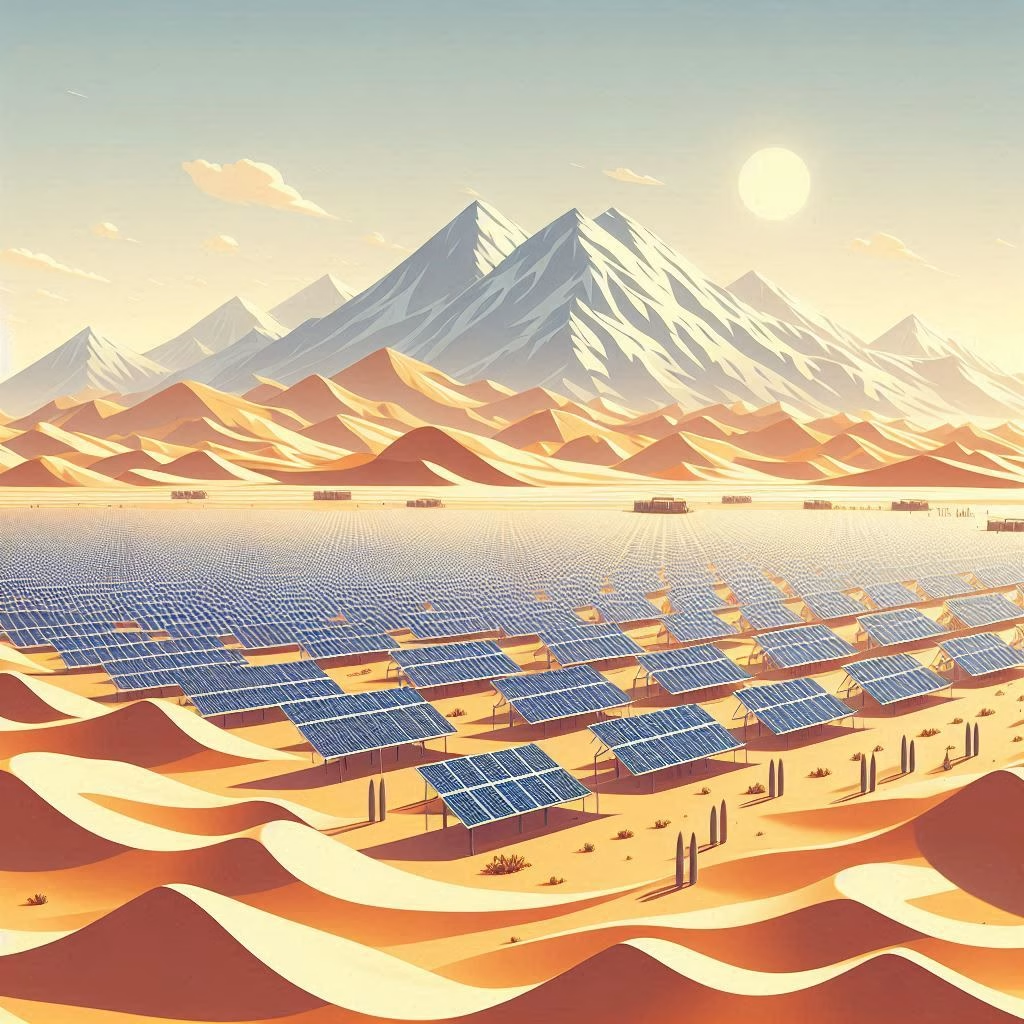
Imagine standing in the middle of a vast desert, surrounded by an endless sea of solar panels, stretching beyond the horizon. This is not science fiction—it is the world’s largest solar park, a colossal engineering achievement that is redefining the way we produce energy.
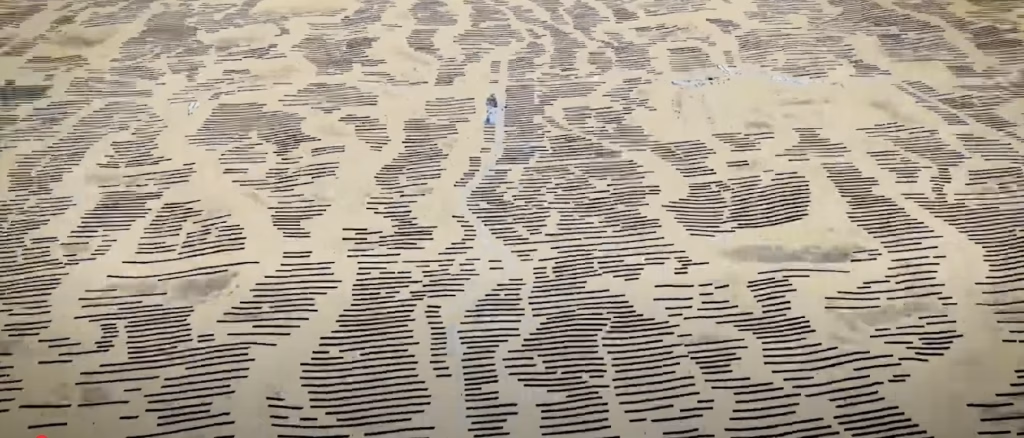
Situated in the Gobi Desert, China’s Midong Solar Park is a 133 km² installation designed to generate 5 GW of power, enough to supply energy to over 2 million households. But how does it compare to traditional power plants? How feasible is the idea of covering deserts with solar panels? And how long will it take to recover the investment? Let’s dive into the details.
The Scale of the Midong Solar Park
To put things into perspective, Midong’s solar park is larger than entire cities—Naples, for example, covers only 117 km². With over 5.26 million solar panels, the project took four years to complete, from 2020 to 2024. The annual electricity production exceeds 6 billion kWh, significantly contributing to China’s ambitious renewable energy goals.
In comparison, the largest solar farm in Europe, the Francisco Pizarro plant in Spain, covers just 13 km² and produces 590 MW—less than one-eighth of Midong’s capacity. Similarly, Italy’s largest solar plant, located in Puglia, consists of only 275,000 panels over 1.5 km² and powers 200,000 people, a fraction of Midong’s output.
How Efficient Are These Solar Panels?
Midong’s efficiency is largely due to the type of solar panels used. The plant primarily utilizes bifacial monocrystalline silicon panels, which are among the most advanced in the industry.
- Bifacial Panels: These can absorb sunlight from both the front and the back, increasing efficiency by up to 30%. Light reflected from the ground is captured by the rear side, making them particularly useful in desert environments where the sand naturally reflects sunlight.
- Monocrystalline Silicon: This type of solar cell has a higher purity level compared to polycrystalline panels, leading to better performance and efficiency, often reaching 22-24% energy conversion rates.
- Desert Conditions: The Gobi Desert provides an ideal setting for solar power generation due to high solar irradiance levels and low atmospheric moisture, reducing energy loss caused by cloud cover.
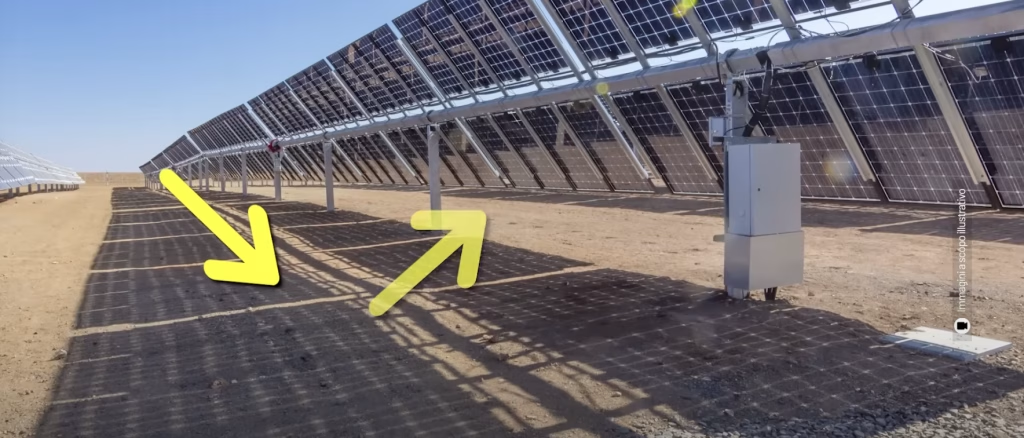
By contrast, older polycrystalline panels typically convert 16-18% of sunlight into electricity, making Midong’s choice of materials a game-changer in renewable energy efficiency.
How Does It Compare to Traditional Power Plants?
A conventional coal power plant with a capacity of 5 GW would require about 15 million tons of coal per year and emit around 13 million tons of CO₂ annually. Midong’s solar farm, on the other hand, avoids emitting 6 million tons of CO₂ per year, replacing fossil fuels with clean energy.
To put that in context:
- One nuclear power plant like the Diablo Canyon plant in California generates about 2.2 GW, meaning you’d need two nuclear plants to match Midong’s output.
- The Three Gorges Dam, the world’s largest hydroelectric station, has an installed capacity of 22.5 GW, but it required flooding an area of 1,045 km² to build. Midong, while still vast, is only 13% of that area and has no impact on river ecosystems.
The Economics: Is The Midong Solar Park a Good Investment?
Solar power has long been criticized for its high upfront costs, but Midong’s project showcases how these concerns are rapidly becoming outdated.
- Total Investment: The estimated cost of the Midong solar farm is around $4.5 billion.
- Annual Revenue: Based on electricity prices in China, the park could generate approximately $1 billion per year in revenue.
- Payback Period: With these figures, the investment could be recovered in 4.5 to 6 years, after which the plant would operate profitably for at least 25-30 years.
- Cost per kWh: The levelized cost of electricity for solar has dropped to as low as $0.03 per kWh, making it cheaper than coal and nuclear energy in many parts of the world.
Get the next one by email
Physics, engineering and the people behind them. No spam, unsubscribe any time.
Can We Cover All Deserts with Solar Panels?
One common question is whether we could cover the world’s deserts with solar panels and solve global energy needs. Theoretically, the answer is yes. The Sahara Desert alone receives enough sunlight to power the world 400 times over if fully utilized. Covering just 1.2% of the Sahara would be enough to meet global electricity demand. However, large-scale deployment faces challenges such as dust accumulation, maintenance costs, and the need for extensive energy storage solutions to compensate for night-time production gaps.
The Role of Energy Storage and Grid Infrastructure
One of the key challenges with large-scale solar energy is energy storage and transmission.
Midong’s solar farm is equipped with grid-scale lithium-ion batteries, helping to store excess energy during the day and release it at night. However, storage technology remains expensive and has a limited lifespan. China is investing heavily in UHV DC transmission lines, capable of transporting electricity over thousands of kilometers with minimal losses, allowing power generated in remote deserts to be delivered to urban centers.
Future Trends in Solar Power
Midong is just the beginning. China has announced plans to build over 450 GW of solar and wind capacity in desert regions by 2030. Future innovations in perovskite solar cells (which have the potential for 30-35% efficiency) and floating solar farms could further revolutionize the industry.
Other countries are following suit:
- India is constructing the Bhadla Solar Park (2.2 GW) in Rajasthan.
- Saudi Arabia is working on the Neom solar-hydrogen project, a 100% renewable-powered city.
- The EU and North Africa are exploring Desertec, a project aimed at supplying Europe with Sahara-generated solar power.
Midong Solar Park: A Glimpse into the Future
The Midong Solar Park is not just the world’s largest solar farm—it is a glimpse into the future of energy. It demonstrates how technological advancements, cost reductions, and large-scale implementation are making solar power more viable than ever. While challenges remain in storage and grid infrastructure, projects like Midong show that a renewable-powered world is not just a dream, but a real possibility within our lifetimes.
The real question is no longer “Can solar power replace fossil fuels?”, but rather “How quickly can we make it happen?”
One story like this, most days
Written by a CERN physicist. No spam, unsubscribe any time.




God asks to shut down solar power plants at the Earth!
The largest solar power plants have recently been launched in the world – in South Africa, India (Bhadla Solar Park, Pavagada Solar Park), China (Midong) and UAE.
The largest solar power plant in 2024 is Midong(China)
it is located in the Xinjiang region, near the city Urumqi.
In most cases, money for the construction of solar power plants was given by the structures of the World Government, the Rothschilds, and various international banks. They pursue the goal of destroying God, splitting and burning Him.
The Climate Investment Fund (CIF) was created in 2008 as a multilateral climate fund to finance pilot projects in developing countries at the request of the G8 and G20. CIF manages a set of programs designed to help countries combat the effects of climate change and accelerate the transition to a low-carbon economy. Tarie Gbadegesin, a citizen of Nigeria and the United States, is the current CEO of CIF.
I am Eva.(I reincarnated and live in Russia) Today I noticed that the rays of the Sun have become somewhat prickly.
Solar batteries are stealing energy of the Sun. Yoga( connection of the planet Earth with the Sun) is being destroyed.You split and burn God over India and iat the Earth,in all Solar System.
At a distance from the Earth to the Sun (149 million km) the Subtle World is being destroyed – the World in which Souls of the dead live. Now the Souls of the dead of the Solar System are descending – from the Sun to the Earth. Because the Subtle World is splitting – yoga (connection with God) of India, China, the UAE and South Africa is being destroyed, and yoga of the Earth, yoga of our Solar System.
Therefore, God of the Sun asks – please urgently and forever turn off all the largest solar power plants of the Earth – in UAE, South Africa, India and China, ideally – all solar power plants of the planet!
It is very hard to God – Souls of dead of the Solar System are leaving him. Without help of God – they will be incarnated weak-willed, insane and unhappy in future. These are tens and hundreds of billions of Souls.
If you do not obey God – then
1 all current authorities of UAE, South Africa, India and China – will soon begin to die – for harm to God and Billions of Souls of dead of the Solar System.
2 After death, the authorities of countries with solar batteries – for stealing energy of God of the Sun will go to hell – at distance of –149 million km, where they will suffer in hell. On planet the Earth – all the authorities of these countries will never reincarnate (for sins) – they will reincarnate only on hellish planets.
3 these countries – UAE, South Africa, India and China – will be severely punished by NATO`s computer the Beast with climate disasters – for fighting against God. And the Beast has already begin to do this.
See – Tornado in the UAE – 10/24/2024, Typhoon “Yagi” in China, Cyclone “Dana” in India and snowfall in South Africa
Therefore, God of the Sun asks – please urgently and forever turn off all the largest solar power plants on planet Earth – in UAE, South Africa, India and China, ideally – all solar power plants on the planet.
Use oil and gas, smaller power plants
For order of God – Eva – Mother of humanity